I do want someone, need someone. You’re right. And? And when I’m with you, I feel like I’m a better person and I feel happier. Less alone. Less lonely.
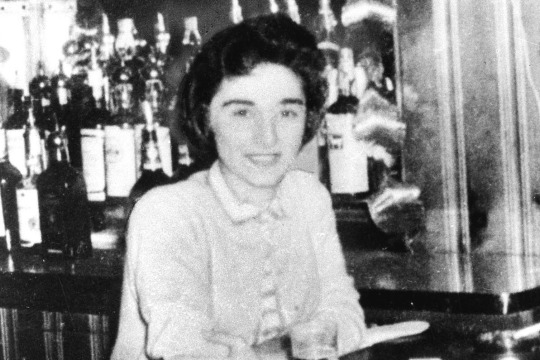
I was told by my professors that Kitty Genovese was a 28-year-old unmarried woman who was attacked, raped, and brutally murdered on her way home from her shift as manager of a bar. I was told that numerous people witnessed the attack and her cries for help but didn’t do anything because they “assumed someone else would”. Nobody intervened until it was too late.
Now… is it likely that people overheard Kitty’s cries for help and ignored them because they thought someone else would deal with it? Or, perhaps, did they ignore her because they knew she was a lesbian and just didn’t care?
Maybe that’s not the case. Maybe it was just a random attack. Maybe her neighbours didn’t know she was gay, or didn’t care.
But it’s a huge chunk of information to leave out about her in a supposedly scientific study of events, since her sexuality made her much more vulnerable to violent crimes than the average person. And it’s a dishonour to her memory.
RIP Kitty Genovese. Society may only remember you for how you died, but I will remember you for who who were.
this was one of the first lessons I had in psych too and we were never told about this either nor was it in any of the reading materials
I never knew this.
I also never knew this about Kitty Genovese, but I do know that, in fact, many of the dozen (not thirty-eight) people who witnessed some part of the attack (which took place after 3AM, on a chilly night in March when most people’s windows were closed) tried to help in some way.
One shouted out his window for the attacker to leave her alone, which did successfully scare the man off temporarily.
Another called the police but, seeing her still on her feet, said only that there had been a fight but the woman seemed to be okay.
And when Kitty Genovese was finally attacked in a vestibule where she couldn’t be seen from outside, Karl Ross, a neighbor, saw what was happening but was too frightened himself to go to her rescue–so he started calling other neighbors to ask what he should do. Eventually one of them told him to call the police, which he did, and the woman he called, Sophie Farrar, rushed out to help Kitty even though she didn’t know whether the attacker was gone.
Kitty Genovese died in the arms of a neighbor who tired to help and comfort her while they waited for the police and ambulance to arrive. Kitty was in fact still alive, although mortally wounded, when the ambulance reached the scene.
The man who saw the final stabbing? Who panicked and called other neighbors first instead of the police? The man who said, infamously, that he “didn’t want to get involved” because he was reluctant to turn to the police for help? He was thought to be gay himself. He was a friend of Kitty and Mary Ann’s. After being interviewed by the police he took a bottle of vodka to Mary Ann and sat with her, trying to comfort her.
So, no. I don’t think the evidence indicates that Kitty Genovese’s neighbors let her die because she was a lesbian, because Kitty Genovese’s neighbors tried to help.
(Also, going by the content of the murderer’s confession, it was indeed a random attack.)
how on EARTH was this “scientifically” studied but the details gotten so wrong and the wrong as hell conclusion published and taught in schools?!?!?! where were those scientists observation skills?! on vacation?!
How to take facts and turn them into an urban legend that gets taught in schools: Make a bad made-for-t.v.-movie about it, watch it, believe everything the movie says, annnnnnnd go! That’s how it gets taught as this supposed “scientific study.” Someone got fucking lazy.
We’re making some overdue improvements to the code that powers our login system. When we make these changes, all Archive users will be logged out of their accounts.
To avoid permanently losing access to your account, please make sure you know your password and/or can receive password reset emails by December 13.
Sure. You can go and learn how to write something. You can learn about the subject you’re writing about. You can investigate. You can work on your craft.
And you can get stuck, and not know what happens next, and wait until you do.
And you can discover that showrunning a tv show you’ve written takes all of your time, and put the novel you’ve been writing to sleep knowing that you won’t be waking it up and carrying on with chapter four until about 20 months have passed.
There aren’t any rules. I wrote a first draft of a first chapter of The Graveyard Book when I was 24, in 1985, and wrote the book between 2004 and the end of 2007. I started Coraline in 1990ish, stopped when I moved to the US in 1992, and finished it in 2000.



















 Molly's Monsters